

Book Review: Atomic Habits
Book: Atomic Habits: An Easy & Proven Way to Build Good Habits & Break Bad Ones
Author: James Clear
BEFORE WE BEGIN
I listened to this book on 1.25 speed, and it took me approximately 4 hours to listen straight through. At regular speed, it clocks in at 5 hours and 35 minutes.
Where to find it (a few of my favorite sources):
TL;DR (Too Long; Didn't Read)
The Bottom Line: A highly readable, research-backed operational guide for developing and maintaining healthy habits that translates behavioral psychology, neuroscience, biology and philosophy into practical systems. An excellent tool for clients needing concrete structure, though it requires thoughtful clinical adaptation.
This Book is Best For: Clients working on routine building, sleep hygiene, behavioral activation, or CBT/ACT goals who benefit from explicit, step-by-step systems.
Use With Caution For: Neurodivergent clients, clients who experience systemic discrimination, clients with eating disorders and body image concerns, clients who struggle with perfectionism and rigid thinking.
Neurodivergent clients: Environmental cues alone often fail without executive function support and micro-steps, and failures may elicit a shame response, making progress even more challenging.
Clients who experience systemic discrimination / have chronic illness: Ignores broader structural, physiological, and socioeconomic barriers to habit formation.
Clients with eating disorders and body image concerns: Frequent default references to weight loss require reframing and caution around potential tracking and restricting behaviors.
Clients who struggle with perfectionism and rigid thinking: Optimization metrics can fuel rigid thinking, tracking fatigue, or self-criticism when streaks break.
With one foot extended, about to step across a tiny stream running like a ribbon down the mountain, I paused. The mountain had moved. Or had it? It sure felt that way. But as we therapists know, feelings are not facts!
I told my friends I felt dizzy and they sprang into action, thrusting a drink at me, pushing sesame crackers into my hands. I barely registered the flurry of activity about me, and within minutes, a significant portion of my pack weight had been distributed amongst them.
Later that morning, I was higher than I’d ever been at 12,500 feet. I’d trained for months in the summer heat and 90 - 95% humidity for this backpacking trip. But how do you train for the elevation of the Colorado Rockies in Austin, Texas? (Even the prescription acetazolamide wasn’t enough to save my sea-level lungs!)
In Atomic Habits, James Clear emphasizes aligning habits with your physical and/or genetic propensities, a lesson I learned the hard way at Columbine Pass. My genetics were working against me at high elevation, and no amount of willpower was going to help. I’m so grateful for my friends’ support getting over the pass, but I won’t be signing up for anything over 10,000 feet again. Forward and onward . . . There are plenty of other adventures to have that don’t involve climbing 12ers!

Starting our descent, 9/3/2026
Atomic Habits is most directly compatible with these modalities:
CBT: To address unhelpful thought patterns such as, “I’m lazy” toward more helpful thoughts such as, “I’m the type of person who exercises multiple times a week.”
ACT: To help overcome limiting beliefs and to clarify values and the actions needed to live in alignment with those values.
DBT: To help overcome blocking behaviors and develop a sense of competence through lessons including Opposite Action, Pros & Cons, Willingness, Build Mastery and Cope Ahead, and PLEASE.
Finally, the heavyweights: Modalities to address trauma and more deeply entrenched beliefs that may thwart clients’ ability to benefit from the strategies described in the book.
Strengths
- Excellent use of stories and examples to introduce concepts, illustrate points and build credibility.
- Extraordinarily well researched. Clear spent years building an arsenal of information backed by research to write this book.
- The author normalizes how hard it can be to build good habits due to the amount of time required to begin to enjoy results.
- The book comes with access to a rich resource library on Clear’s website, including cheat sheets and worksheets to help with implementation.
Weaknesses
- The book places a lot of focus on optimization, which can quickly erode joy, spontaneity, flexibility and many of the things we may be helping our clients discover and experience more of in their lives.
- Not surprisingly, given the note on optimization above, when you sign up for Clear’s free course, you’re prompted to sign up for Andrew Huberman’s newsletter. Invite me for a coffee if you ever want the full rant on Andrew Huberman. I’m not a fan. ;)
- The book doesn’t acknowledge how developing and maintaining healthy habits can be harder for certain populations (see the “My Take” section below for more on this).
- If you listen to the audiobook, accessing the free resources can be confusing. You will need to sign up for the e-course (free) and then follow a tiny link at the bottom (see screenshot below).
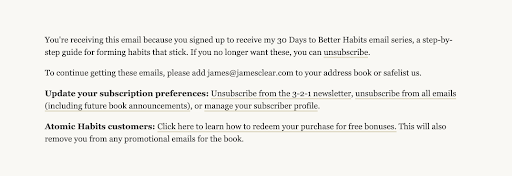
You will want to click on the bottom link, “Click here to learn how to redeem your purchase for free bonuses.”
My take
The first time I listened to this book, I’ll admit I was put off by his lack of mention - and therefore seeming lack of awareness of - the systemic, psychological and neurodevelopmental factors that make it harder for some people to develop healthy habits and give up unhealthy ones. Also, as a Health at Every Size-aligned therapist who has worked with clients with eating disorders and whose caseload comprises approximately 90% of clients with body image concerns, I wasn’t fond of his repeated use of weight loss as an example of a desirable goal.
It was with this lens that I started the second listen. And while those are serious concerns, the book distills extremely well-researched information into interesting vignettes and practical applications, making the psychology underpinning his recommendations accessible to the masses.
A few key concepts & takeaways
| Core Framework | Key Takeaways & Strategies |
|---|---|
| Systems vs. Goals | Ensuring you have effective systems is more effective for developing habits than setting goals. The idea is to develop the system to support the habit because over-indexing on the goal often leads to giving up the habit once the goal is achieved. |
| 3 Aims of Behavior Change |
Clear breaks down behavior change into three aims:
|
| The 4 Laws of Behavior Change He also groups habit forming, and the inverse, into four laws, and provides strategies for addressing each. You’ll recognize classical and operant conditioning throughout the applications of the laws. |
|
| Law 1: The Cue Make it obvious |
|
| Law 2: The Craving Make it attractive |
|
| Law 3: The Response Make it easy |
|
| Law 4: The Reward Make it satisfying |
|
Some general thoughts
It’s important to remember that doing something is better than nothing at all. For instance, if you’ve successfully built your reading habit from one minute to 15 minutes a night, and you don’t have 15 minutes, it’s better to do even one minute than nothing at all to keep up your reps and reinforce the habit. And if you do miss a day, get back to it immediately to resist the all-or-nothing trap that the habit is broken.
The Goldilocks Rule says that the best way to stay motivated is to ensure a challenge is not too easy and not too hard. You want to reach, but you don’t want to feel discouraged.
Something that can be especially hard for our neurodivergent clients: Tolerance of boredom is correlated with success in developing habits and achieving broader goals because repetition is prone to create boredom. We may need to encourage our neurodivergent clients to find ways to add spice to the reps to keep motivation high.
So… would I recommend this book to clients? Absolutely, but with a caveat for specific populations. For example:
Neurodivergent Clients
The environmental design strategies may be less effective with neurodivergent clients, so I would highly encourage my neurodivergent clients to pair the concepts in this book with worksheets to help them break down the steps into very small, manageable bits. Clear’s worksheets are excellent, and I personally like to provide clients multiple options so they can find what will work best for them. I will also take extra care to check regularly for a shame response, encouraging them to remember their challenges represent a brain wiring difference and uncouple that difference from any ties to their character or value.
Systemic Discrimination, Serious Mental Illness & Chronic Illness
All of these groups are likely going to find implementing the strategies in this book more challenging than the general population. For starters, many have experienced years of hearing that something is wrong with them or they are “not enough”, and these beliefs can become deeply encoded, working in direct opposition to the strategies outlined in the book. Not to mention, even a micro-step can feel overwhelming to a client with less time and fewer resources. I recommend leaning heavily into self-compassion, allowing lots of time for the changes and celebrating wins liberally in addition to treating the trauma that may lie beneath the surface.
Clients Struggling with Perfectionism
These clients may need extra support when the going gets tough to keep the momentum even when they miss the mark, particularly because they may be susceptible to harsh criticism and all-or-nothing thinking. An example in my own life (TMI?) is wearing my mouth guard at night. Have you ever met anyone who likes wearing their mouth guard? Instead of aiming for 7/7 nights, I aim for 6/7 nights. If I miss, it’s no big deal and I easily get back to it. I probably actually achieve 7/7 nights very regularly, but I don’t aim for or expect 7/7. And it took me time to work up to 6/7 as a goal! And when I slip - as I do - I treat each day as a new opportunity to wear it. Trust me, it took a long time to get to this place!
Eating Disorders & Body Image Concerns
I would warn clients of the misalignment with the HAES and intuitive eating framework, and carefully (yet gently) monitor for an increase in body checking and restricting behaviors.
Let me know if you’re inspired to work on some of your habits. I’m planning to do several things in particular:
Set a day, time and place for practicing guitar each week (e.g., “I will practice guitar on Tuesday nights at 7:30 pm.”).
Place my guitar in my living room to use environmental design to my advantage and have regular reminders.
Every time I get into my car to drive somewhere, I will take two deep breaths before starting the engine (an example of habit stacking).
I would love to hear yours! Be my accountability partner, anyone?
Additional resources:
https://jamesclear.com/atomic-habits/media
**Hey curious minds! This is my first book review, or blog post, for Curious Therapist, period! I would love your feedback and comments so I can improve future content. Thank you for being here, and thank you for staying curious!
